Ladue Deer Creek Preserve Summer Guide and Local Loop
July 23, 2026
July 23, 2026
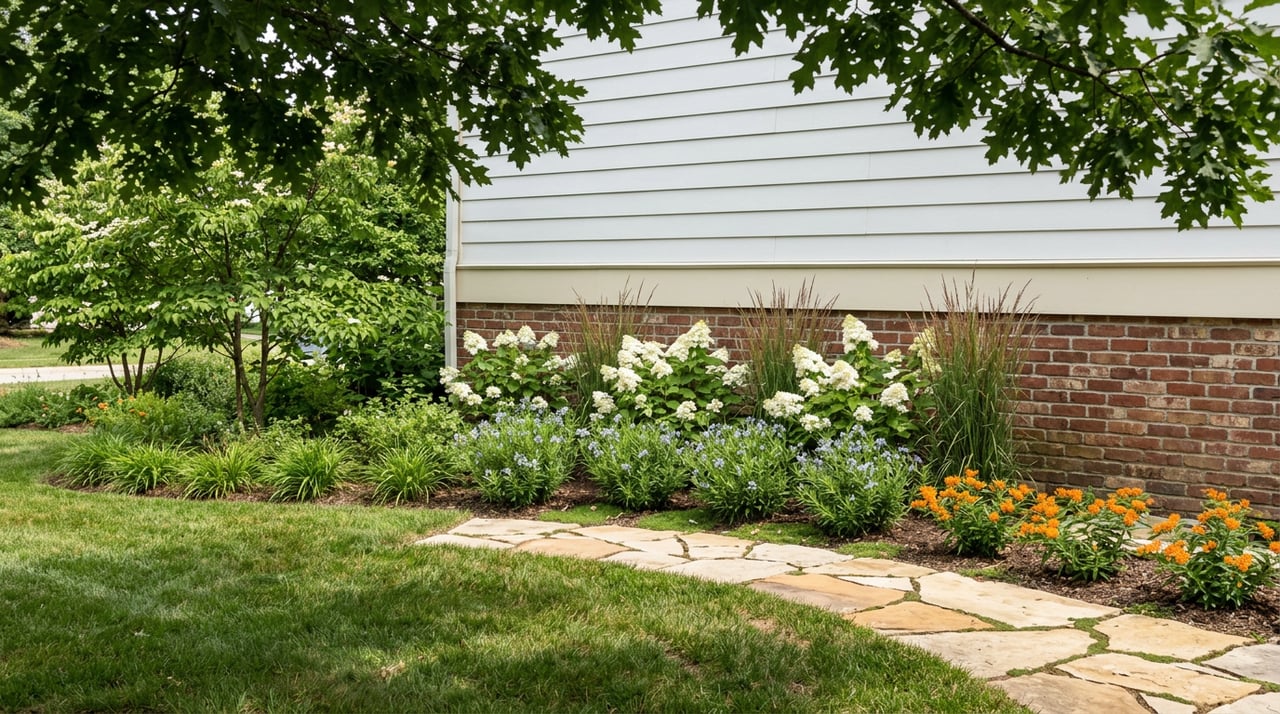
Every neighborhood has a story about a piece of land that stopped being useful and had to be reimagined. In Ladue, that piece of land sits at 9810 South Forty Drive, and for most of the last decade it smelled like wet leaves. What it smells like now, in July, is cut grass and honeysuckle sap, because a small circuit of parks, gardens, and volunteer projects has quietly turned the old service yard into the closest thing this part of the county has to a shared backyard.
If you have lived here more than a few years, you have watched the transition in fragments. A survey mailer. A ribbon of new asphalt. A goat. This post is the version of the story that puts the fragments in order, tells you what is on the summer calendar, and explains what the next round of construction would actually connect.
The parcel was purchased from Ameren in 1988 and, for almost thirty years, functioned as the city's leaf and brush processing yard. It was named for Mayor Edie Spink, who served from 1975 to 1995. By 2017, the math on the program had stopped working. The city's own accounting cited rising management costs against a resident participation rate of just 11 percent, and the leaf mulch operation was shut down.
What followed was not glamorous. From 2021 through 2023, Metropolitan Sewer District crews tore up the site as part of the Deer Creek sanitary sewer replacement. For two summers, the parcel looked worse than it had when it was a mulch pile. Then Phase I of the preserve opened in 2024, with an initial trail system, a bridge over the creek, scattered benches, and 69 native trees in the ground. The roughly $750,000 cost was covered primarily by MSD and the Municipal Park Grant Commission, with plantings underwritten by the Ladue Garden Club and the Garden Club of St. Louis.
The result is 14 acres of city-owned land, more than 11 of which are set aside for passive use. That is the current preserve. The interesting part is what has grown up around it.
The 2026 Ladue Parks calendar reads less like a municipal schedule and more like a working plan for the year. If you are trying to figure out what is worth putting on the family calendar between now and fall, these are the anchor dates:
If you missed the tour and Arbor Day this year, the takeaway is that both are annual. The garden tour in particular is the kind of event that residents book their weekend around and out-of-towners never hear about.
Deer Creek Preserve on its own is a pleasant twenty minutes. Stitched together with the two other pieces of green space within walking distance, it becomes a real morning. The Litzsinger Road Ecology Center sits about seven-tenths of a mile away and is one of the few sites in the county actively used for K-12 outdoor curriculum. Rodes Park, at Ladue Road and Warson Road, has been the Garden Club of St. Louis's daffodil project for years, with plantings supervised by local expert Jason Delaney and a running tradition of dogwood trees planted in memory of members.
The city is now building Rodes into something more substantial. The current long-term plan includes a bridge, additional paths, benches, and native plantings, developed in partnership with the two garden clubs. The through-line is worth naming: three sites, all inside a two-mile radius, all being upgraded at the same time by the same set of institutions. That is not usually how park systems evolve. It is happening here because the volunteer bench is unusually deep.
The recent opening of the walking trail at Deer Creek Preserve provided the opportunity to plant native trees near the former Edie's Mulch Site, funded through the Living Legacy Fund and grants from the Garden Club of St. Louis and the Ladue Garden Club.
That Living Legacy program is the mechanism worth knowing about if you have lost a parent, a neighbor, or a longtime pet this year. Residents can donate a tree in someone's name toward the 43 remaining trees on the preserve's planting plan. It is a quieter alternative to a memorial bench, and the trees are actually going in the ground now, not five years from now.
The current preserve is a single spur trail. The proposed Phase 2 concept, which was the subject of last fall's community survey, adds a second looped trail and a scenic overlook along the creek itself. The city plans to submit the grant application in 2026, which means construction is realistically a 2027 or 2028 project depending on the funding cycle.
The more consequential piece is the shared-use path extension along South Forty Drive. Ladue has submitted a federal Transportation Alternative Program application to build an off-street path that would connect Deer Creek Preserve east to the Trails End subdivision and west to the intersection of Clayton Road and South Forty. Here is why that matters in practical terms:
| Element | Today | If S. Forty extension is funded |
|---|---|---|
| Access to DCP | Drive to the lot at 9810 S. Forty | Walk or bike from Trails End and adjacent blocks |
| Connection to Clayton Rd. corridor | Requires driving or sharing Clayton Rd. with commuter traffic | Off-street link to the Clayton and S. Forty intersection |
| Position in county trail network | Standalone city preserve | Candidate segment toward Great Rivers Greenway's 300-plus mile system |
The BOSTA committee, which handles bike, open space, and trail advocacy for the city, is already in conversations with utility owners, adjacent country clubs, and residents about further linkages. If those conversations produce right-of-way, Ladue quietly moves from being a place with a nice local park to a place with a functioning piece of the regional greenway. That is a different kind of neighborhood.
Some of the changes at the preserve are big enough to attend a ribbon cutting for. Others are the kind of small choices that tell you where a place is headed.
A Washington University student recently donated a Little Free Library that now sits along the trail. Neighbors have already stocked and cycled the shelves. The Goats on the Go herd, which does the annual honeysuckle work at Arbor Day, is a genuinely charming thing to explain to a five-year-old and also a functional piece of ecological maintenance. The Ladue Garden Club's pollinator garden inside the preserve was designed specifically for bees, butterflies, and moths and is starting to look, at year two, like it was always there.
None of these are amenity claims a developer would put on a brochure. They are the details that tell you a neighborhood is being maintained by people who actually live in it, not by a management company running a checklist. That distinction is the one worth trusting when you are deciding whether to stay, renovate, or move within Ladue and Frontenac.
The short version is this. You already know Ladue for its restaurants along Clayton Road, for Plaza Frontenac, for the country clubs. What has changed in the last two summers is that a real outdoor circuit has grown up on the north side of Highway 40, one that connects a former mulch yard, a daffodil park, and an ecology center into a route you can actually walk. The next round of city grant applications will decide how connected that circuit becomes to the rest of the county. If you have opinions about the Phase 2 loop, the city is still collecting them.
When it is time to think about what your home is worth in a neighborhood that is quietly becoming more walkable, or how to position a listing so the buyer understands the difference between a Ladue address in 2020 and a Ladue address now, Christine Neskar works with residents across Ladue, Frontenac, and the surrounding suburbs. Schedule a Consultation to talk through what the recent changes mean for your specific block.
Stay up to date on the latest real estate trends.
With decades of experience, proven negotiation skills, and a deep understanding of the St. Louis market, this professional guides clients through smooth, successful real estate journeys.